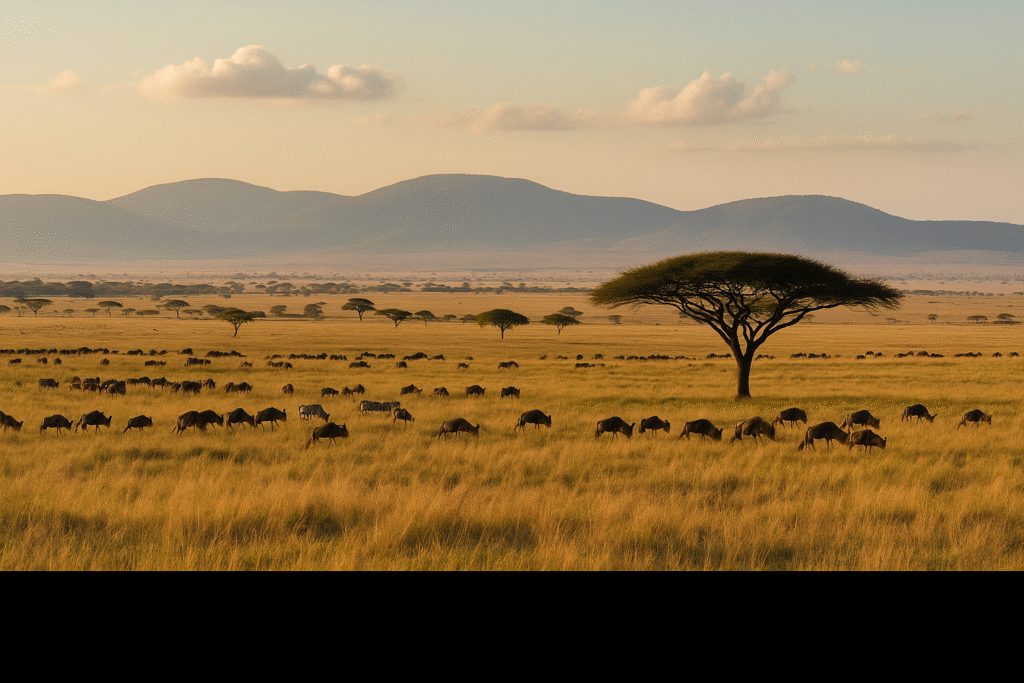
Serengeti National Park in Tanzania has once again secured the prestigious title of Africa’s Leading National Park at the 2025 World Travel Awards. This marks the seventh consecutive win since 2018, underscoring its enduring significance as one of the continent’s most iconic and ecologically vital conservation areas.
Located in northern Tanzania and extending into south-western Kenya, the Serengeti is globally recognised for its unspoilt wilderness and the extraordinary ecological event known as the Great Migration. Each year, more than 1.5 million wildebeest, accompanied by hundreds of thousands of zebras and gazelles, traverse the plains in a relentless search for water and grazing. This cyclical journey, covering nearly 3,000 kilometres, is widely acknowledged as one of the greatest natural spectacles on Earth. The migratory pattern is not only a vital survival mechanism for the animals involved but also plays a crucial role in shaping the park’s ecosystem and biodiversity.
Beyond its migratory drama, the Serengeti is a repository of remarkable biodiversity. The park is home to the so-called “Big Five” (lion, elephant, leopard, buffalo, and rhinoceros), as well as cheetahs, hyenas, crocodiles, giraffes, and over 500 species of birds. It encompasses a diverse range of habitats including savannahs, riverine forests, swamps, and kopjes, which support this variety of flora and fauna.